
BioPROTAC, PROTAC or Molecular Glue?
All three are targeted protein degraders. All three end the same way, with a target protein destroyed by the proteasome instead of merely blocked. The differences sit upstream of that shared ending, in what does the targeting, what the target has to offer in return, and how the thing gets into a cell.
Those differences decide which modality can touch your target at all. A PROTAC needs a pocket. A molecular glue needs a surface that happens to fit a remodelled ligase interface. A bioPROTAC needs neither, and pays for that reach with a delivery problem. This is a comparison of the three on the terms that actually constrain a program.
What All Three Share
Every cell runs a disposal pipeline. Proteins tagged with ubiquitin are pulled into the proteasome and broken down, constantly, as routine housekeeping. An E3 ubiquitin ligase decides what gets tagged. Every degrader modality is a way of lying to an E3 ligase about what belongs on its list.[1]
That shared mechanism carries a shared advantage over inhibition. Blocking a protein is occupancy-driven: the drug has to be present, in sufficient concentration, at the active site, continuously. Degrading a protein is event-driven. Once the target is tagged and destroyed, the degrader is free to do it again, which means a single molecule can turn over many copies of its target and the effect outlasts the exposure.[2]
It also removes the whole protein rather than one of its activities. For a scaffolding protein or a transcription factor, where the problem is a set of interactions rather than a catalytic site, that is the difference between a partial effect and the intended one.
So the choice between the three is never about whether degradation is the right idea. It is about which construction can be built against the particular protein in front of you.
PROTAC: Two Warheads And A Linker
How it works
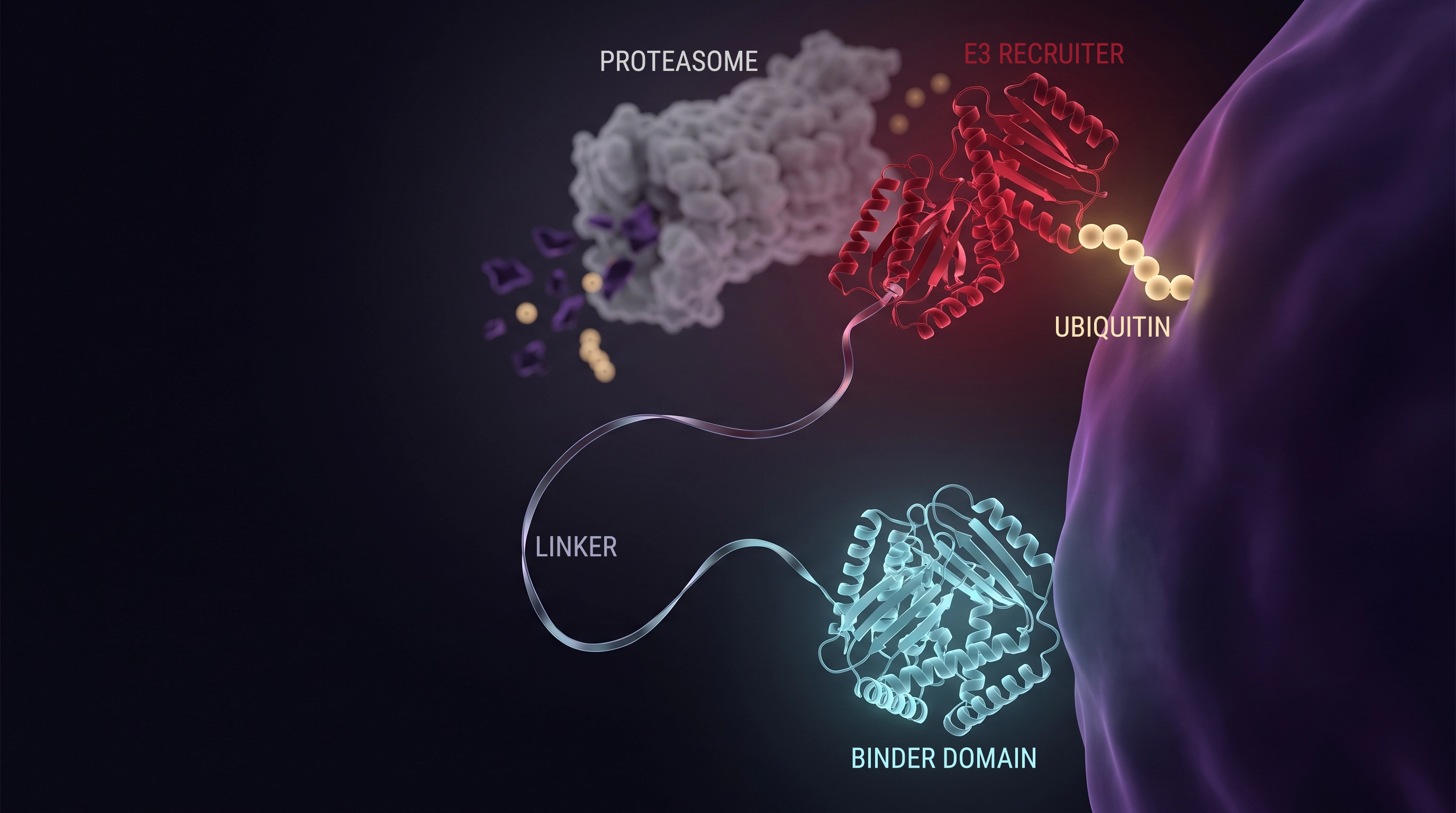
A PROTAC (proteolysis-targeting chimera) is one synthesized molecule doing two jobs. One end binds the target protein. The other end binds an E3 ligase. A linker holds them at a workable distance. When both ends are engaged at once, the molecule bridges target and ligase into a three-body assembly called a ternary complex, and it is that complex which gets the target ubiquitinated.
What the target has to provide
A pocket. The target-binding end is a small molecule, so it needs somewhere to wedge into, which means a PROTAC program starts from a ligandable site and a reasonable starting ligand. This is the central constraint of the modality. Identifying high-affinity ligands to serve as PROTAC starting points remains a recognized bottleneck, and no amount of linker optimization substitutes for a binding site that does not exist.[3] The pocket does not have to be a functional one, which is a real liberation: a PROTAC can bind a site that has nothing to do with the protein's activity, because it needs a handle rather than an off switch. But it does have to be a pocket.
Where the engineering gets hard
Ternary complexes are not simply the sum of two binding events. They show cooperativity, where target and ligase either stabilize or destabilize each other's binding, and they show the hook effect, where raising the concentration of the degrader past a certain point reduces degradation instead of increasing it, because the molecule begins saturating target and ligase in separate two-body complexes rather than bridging them. Potency is therefore not monotonic in dose, and the biophysical characterization needed to navigate that is substantial.[2]
Then there is size. Fusing two binders and a linker produces molecules that sit outside conventional small-molecule property space, in what medicinal chemists call "beyond Rule of 5" territory, where solubility and cell permeability stop behaving predictably and the criteria for forecasting druglike properties are still underdeveloped. Permeability often turns out to be the limiting factor in cellular potency rather than ternary complex formation, which means a PROTAC can look strong in a binding assay and fail in a cell for reasons that have nothing to do with degradation itself.[4]
Why it is still the most advanced of the three
Because it is a small molecule, it is administered like one. No delivery vehicle, no expression construct, oral dosing on the table. That is a decisive practical advantage and it shows in the clinic. The modality went from first report in 2001 to more than fifteen targeted degraders in clinical testing by 2022, spanning kinases, nuclear receptors and epigenetic proteins.[5]
The clinical data also establish something this comparison should credit plainly: degradation can succeed where inhibition has failed on the very same target. BTK degraders were developed for patients whose disease had become refractory to covalent BTK inhibitors, and because they destroy the protein rather than occupy a site on it, they overcome the resistance mutations that defeat those inhibitors. Early clinical trials of several such agents report durable benefit.[6]
Molecular Glue: One Molecule, Induced Proximity
How it works
A molecular glue is monovalent. One small molecule, no linker, no second warhead. It binds an E3 ligase and alters the shape of that ligase's recognition surface, creating an interface which was not there before. A protein the ligase would normally ignore now fits against it, and gets ubiquitinated as a consequence. The glue does not hold the target so much as it rebuilds the ligase into something that will.[7]
What it buys you
Being one modest-sized molecule rather than two joined together, a glue keeps favourable physicochemical properties and sidesteps most of the size and permeability penalty that burdens PROTACs. It also needs no pre-existing ligand for the target, which in principle opens proteins that cannot be ligandable at all. Thalidomide and its derivatives, which reprogram the E3 ligase cereblon, are the best understood examples and are powerful cancer therapeutics.[8]
The catch: you do not choose the target
With a PROTAC or a bioPROTAC you pick a target and build toward it. With a glue, the compound decides which proteins become degradable, and whether your protein is among them is a property of its surface rather than a design decision. This is why the clinically important glues were found by accident before they were ever designed on purpose.[9]
That is changing, and the comparison should not freeze the field a decade ago. Structural work on how glues remodel cereblon has produced genuine recognition rules, centred on a structural degron motif, and analysis of the human proteome suggests current cereblon-based glues could in principle recognize thousands of proteins carrying that motif. Deliberate screening strategies now sit alongside the serendipitous discoveries.[8][7] Rational glue design is real. It remains bounded by which target surfaces a given ligase can be persuaded to accept.
BioPROTAC: A Degrader Made Of Protein
How it works
A bioPROTAC keeps the bifunctional logic of a PROTAC and changes the material. The target-binding warhead becomes a genetically encoded binder domain, a DARPin, a nanobody, a designed miniprotein or a peptide, fused directly to an E3 ligase or to a ligase-recruiting domain. The construct is a single engineered protein, so there is no linker chemistry to optimize and no synthesis to repeat.[3]
Why it reaches targets the others cannot
Protein binders recognize protein surfaces. That is their native job. A binder domain can engage a broad, shallow interface with no groove in it, which is precisely the geometry that leaves a target labelled undruggable. The modality is also notably tolerant in construction: the foundational work showed considerable flexibility in both the choice of binder scaffold and the choice of E3 ligase, meaning the design space is large rather than a single privileged pairing.[3]
Two published examples make the point concretely. HuR, an RNA-binding protein whose overexpression tracks with poor prognosis, had resisted small-molecule antagonism; a single-domain antibody against it was built into a TRIM21-based bioPROTAC, and degrading HuR reversed tumour-promoting properties of cancer cells in vivo.[10] And for the oncogenic phosphatase SHP2, bioPROTACs were shown to degrade gain-of-function mutants that are otherwise difficult to hit selectively with small-molecule constructs, with bivalent target recruitment emerging as a general way to raise potency.[11]
Specificity is itself engineerable. Binding scaffolds selected by directed evolution against a chosen antigen can be installed into TRIM21 in place of its native substrate-binding domain, redirecting the ligase at a new target while preserving its catalytic activity. That is a repeatable procedure for pointing the degradation machinery somewhere new, not a one-off result.[12]
Iteration without a chemistry campaign
A bioPROTAC is a sequence, so a design change is an edit rather than a resynthesis. Variants can be generated computationally and tested in cells in large batches, and reporter assays built for exactly this purpose have screened libraries of candidate degraders to pull out the ones that work.[13] This is the structural reason the modality iterates faster than chemistry: the cost of trying another candidate is close to the cost of writing it down.
The honest constraint: delivery
A bioPROTAC has to be inside the cell to work, and it is a protein, so it does not simply diffuse there. Either the protein is delivered or the gene encoding it is, which brings in the whole apparatus of biologic and gene delivery: vectors, tissue targeting, expression control, immunogenicity. A PROTAC or a glue is swallowed. This is the trade the modality makes, and it is the main reason bioPROTACs sit earlier on the clinical path than small-molecule degraders.
It is worth noting that the field is actively engineering around this rather than waiting. Protease-responsive linkers have been used to put bioPROTAC activity under conditional control, so that degradation responds to a small-molecule or optical input instead of running constitutively.[14] For target validation work, where the construct only needs to reach cells in a dish, the delivery constraint is substantially less binding than it is for a therapeutic.
Side By Side
PROTAC
Two chemical warheads joined by a linker. Each needs a pocket to wedge into.
Molecular glue
One molecule reshapes the ligase surface until the target fits against it.
BioPROTAC
A binder domain fused directly to the ligase. A flat surface is enough.
| BioPROTAC | PROTAC | Molecular Glue | |
|---|---|---|---|
| What it is | An engineered protein: binder domain fused to an E3 ligase or ligase-recruiting domain | A synthesized bifunctional small molecule: two warheads joined by a linker | A single small molecule, monovalent, no linker |
| How targeting works | The binder domain holds the target directly | One warhead holds the target directly | The ligase surface is remodelled so it accepts the target |
| What the target must offer | Any accessible protein surface; no pocket required | A ligandable pocket, plus a usable starting ligand | A surface compatible with the glue and ligase pairing, often a recognizable degron motif |
| Target chosen by | You: the binder is designed against your target | You: the warhead is chosen against your target | The compound: the glue determines what becomes degradable |
| Delivery | Gene delivery or protein delivery into the cell | Conventional small-molecule dosing, oral routes feasible | Conventional small-molecule dosing, oral routes feasible |
| Iteration cycle | Sequence edit plus cell-based screening; no synthesis step | Synthesis and resynthesis of warheads and linker each round | Chemical synthesis, with target scope discovered rather than specified |
| Principal constraint | Getting the construct into the right cells | Finding a pocket, then permeability and the hook effect | Limited control over which targets are addressable |
| Clinical maturity | Preclinical, with in vivo proof of concept published | Most advanced: multiple agents in clinical trials | Approved therapeutics exist, though mostly discovered before the mechanism was understood |
Which One Fits Your Target
The decision is usually made for you by the target, not by preference. A few patterns recur.
Your target has a good pocket and you need an oral drug
Start with a PROTAC. The delivery route is solved, the modality has clinical precedent, and if a competent ligand already exists you are starting from the hardest part already done. Expect to spend the program on linker optimization, permeability and ternary complex behaviour rather than on finding the target.
Your target carries a surface a known glue can exploit
Pursue the glue. The physicochemical properties are the friendliest of the three and the mechanism is efficient. The catch is that you cannot will this situation into existence. It is worth checking whether your target presents a compatible motif, and worth not building a program on the hope that it does.
Your target has no pocket, or no selective one
This is the bioPROTAC case, and it covers more ground than it first appears to. It includes the classic pocketless targets, scaffolding proteins and transcription factors. It also includes targets with a pocket that cannot be hit selectively, such as a mutant that differs from its wild-type counterpart only at a surface a small molecule cannot discriminate. Protein binders can read those differences.
You need to know whether degrading the target does anything at all
Use a bioPROTAC as the tool, whatever you eventually intend to develop. It is the fastest way to remove a specific protein from a cell and look at the consequence, and it answers the target validation question before anyone commits to a chemistry campaign. A negative answer here is worth a great deal, and it is cheapest to obtain this way.
Not Actually A Horse Race
The three modalities are usually framed as competitors, and for a given target one of them is generally the right answer. Across a portfolio they behave more like a sequence. A bioPROTAC can establish that degrading a protein produces the phenotype you want, which is the expensive uncertainty in any degrader program. That result then justifies the search for a small-molecule handle, or it kills the target before the chemistry budget is spent.
The wider degradation field has also stopped being three options. It now includes chimeras that route targets to the lysosome rather than the proteasome, antibody-based constructs that work on membrane proteins, and nanoparticle-mediated approaches, all of which rest on the same principle of induced proximity.[1][15] The question worth asking is not which modality wins, but which one can be built against the protein you care about.
Where ProxAI Works
ProxAI builds the third kind: genetically encoded degraders against targets with no pocket worth the name. Two programs, both against flat interfaces, both from a single design round.
Against the CDC20 D-box degron interface, a 9-amino-acid de novo peptide drove a 9.3× cell-death response versus negative control in HeLa cells, at 2.7× the potency of Apcin, a known small-molecule CDC20 inhibitor. Read the CDC20 case study.
Against a kinase-effector interface in an inflammation pathway, a 90-amino-acid de novo minibinder delivered 82% suppression of the target effector while leaving the target's remaining functions intact. Read the inflammation case study.
Both numbers came out of live cells. Neither is a docking score. If you are still deciding which modality your target can support, that conversation is worth having before the chemistry budget is committed. For the fundamentals, start with what bioPROTACs are.
FAQ
Is a bioPROTAC just a PROTAC made out of protein?
Functionally it occupies the same role, but the difference is not cosmetic. Both are bifunctional and both route a target into the ubiquitin-proteasome system. A PROTAC uses a small-molecule warhead that needs a ligandable pocket, while a bioPROTAC uses a genetically encoded binder domain that can engage a broad, shallow protein surface. That single swap changes which targets are reachable, how the construct is delivered, and how fast it can be iterated.
Which modality works on a target with no binding pocket?
BioPROTACs are the most direct answer, because a protein binder domain can recognize a flat protein-protein interaction surface that no small molecule can occupy. Molecular glues can sometimes reach pocketless targets too, but only where the target surface happens to be compatible with a glue-remodelled E3 ligase interface, which is not something you can specify in advance for an arbitrary target.
Can molecular glues be designed rationally, or are they always found by accident?
Historically most clinical molecular glues were discovered serendipitously, thalidomide and its derivatives among them. That is changing. Structural understanding of how glues remodel the cereblon surface has produced recognition rules, including a degron motif that is present in a large share of the human proteome, and dedicated screening strategies now exist. Rational glue design is real but still constrained to target surfaces compatible with a given ligase.
What is the hook effect, and do bioPROTACs have it?
The hook effect is the loss of degradation seen at high concentrations of a bifunctional degrader, where the molecule saturates the target and the ligase separately instead of bridging them into a productive ternary complex. It is a well-characterized consideration for small-molecule PROTACs. Any bifunctional degrader that depends on forming a three-body complex can in principle show the same behaviour, so expression level and binder affinity are design variables for bioPROTACs rather than problems that disappear.
Which modality is the fastest route to a usable research tool?
Usually a bioPROTAC, because it is a sequence rather than a synthesized compound. Changing the binder domain or the E3 ligase is an edit to a construct, so a design round can test large numbers of variants in cells without a chemistry campaign. For target validation work, where the goal is to remove a protein and observe the phenotype rather than to ship an oral drug, that iteration speed usually matters more than delivery convenience.
References
-
Zhao L, Zhao J, Zhong K, Tong A, Jia D. Targeted protein degradation: mechanisms, strategies and application. Signal Transduct Target Ther. 2022;7(1):113. doi:10.1038/s41392-022-00966-4
-
Casement R, Bond A, Craigon C, Ciulli A. Mechanistic and structural features of PROTAC ternary complexes. Methods Mol Biol. 2021;2365:79-113. doi:10.1007/978-1-0716-1665-9_5
-
Lim S, Khoo R, Peh KM, et al. bioPROTACs as versatile modulators of intracellular therapeutic targets including proliferating cell nuclear antigen (PCNA). Proc Natl Acad Sci U S A. 2020;117(11):5791-5800. doi:10.1073/pnas.1920251117
-
Klein VG, Bond AG, Craigon C, Lokey RS, Ciulli A. Amide-to-ester substitution as a strategy for optimizing PROTAC permeability and cellular activity. J Med Chem. 2021;64(24):18082-18101. doi:10.1021/acs.jmedchem.1c01496
-
Wang C, Zheng C, Wang H, Zhang L, Liu Z, Xu P. The state of the art of PROTAC technologies for drug discovery. Eur J Med Chem. 2022;235:114290. doi:10.1016/j.ejmech.2022.114290
-
Salvaris RT, Brennan J, Lewis KL. BTK is the target that keeps on giving: a review of BTK-degrader drug development, clinical data, and future directions in CLL. Cancers (Basel). 2025;17(3):557. doi:10.3390/cancers17030557
-
Domostegui A, Nieto-Barrado L, Perez-Lopez C, Mayor-Ruiz C. Chasing molecular glue degraders: screening approaches. Chem Soc Rev. 2022;51(13):5498-5517. doi:10.1039/d2cs00197g
-
Oleinikovas V, Gainza P, Ryckmans T, Fasching B, Thomä NH. From thalidomide to rational molecular glue design for targeted protein degradation. Annu Rev Pharmacol Toxicol. 2023;64:291-312. doi:10.1146/annurev-pharmtox-022123-104147
-
Dong G, Ding Y, He S, Sheng C. Molecular glues for targeted protein degradation: from serendipity to rational discovery. J Med Chem. 2021;64(15):10606-10620. doi:10.1021/acs.jmedchem.1c00895
-
Fletcher A, Clift D, de Vries E, et al. A TRIM21-based bioPROTAC highlights the therapeutic benefit of HuR degradation. Nat Commun. 2023;14(1):7093. doi:10.1038/s41467-023-42546-2
-
Hoffman M, Krum D, Wittrup KD. Bivalent target-binding bioPROTACs induce potent degradation of oncogenic SHP2. J Biol Chem. 2024;300(9):107616. doi:10.1016/j.jbc.2024.107616
-
VanDyke D, Xu L, Sargunas PR, et al. Redirecting the specificity of tripartite motif containing-21 scaffolds using a novel discovery and design approach. J Biol Chem. 2023;299(12):105381. doi:10.1016/j.jbc.2023.105381
-
Hoffman M, Cheah KMH, Wittrup KD. A novel gain-of-signal assay to detect targeted protein degradation. ACS Synth Biol. 2024;13(1):220-229. doi:10.1021/acssynbio.3c00447
-
Yang H, Chen W. Protease-responsive toolkit for conditional targeted protein degradation. ACS Synth Biol. 2024;13(7):2073-2080. doi:10.1021/acssynbio.4c00014
-
Baker AG, Ho APT, Itzhaki LS, Fruk L. Nanoparticle-mediated targeted protein degradation: an emerging therapeutics technology. Angew Chem Int Ed Engl. 2025;64(28):e202503958. doi:10.1002/anie.202503958